3D Mobile Data Security Concept: A New Era of Digital Protection
The 3D Mobile Data Security Concept represents a groundbreaking approach to safeguarding sensitive information on mobile devices. By integrating three-dimensional design elements with advanced security protocols, this concept offers a visually engaging and technically robust solution for protecting digital assets. Whether you're a developer, designer, or business owner, understanding the potential of 3D Mobile Data Security Concept can open new avenues for innovation and protection.
This concept leverages the power of 3D modeling and animation to create interactive interfaces that enhance user awareness and engagement with security measures. From visualizing data encryption processes to illustrating secure authentication methods, 3D Mobile Data Security Concept provides a dynamic way to communicate complex ideas in an intuitive manner.
Key Characteristics of 3D Mobile Data Security Concept
One of the defining features of the 3D Mobile Data Security Concept is its ability to transform abstract security principles into tangible, visual experiences. This is achieved through the use of 3D models that represent data flow, encryption algorithms, and network traffic patterns. These models are not only aesthetically pleasing but also serve as educational tools that help users understand how their data is protected.
Another notable characteristic is the integration of interactive elements. Users can manipulate 3D objects to explore different aspects of mobile security, such as biometric authentication, secure cloud storage, and device encryption. This interactivity makes the learning process more engaging and effective, especially for those who may not have a technical background.
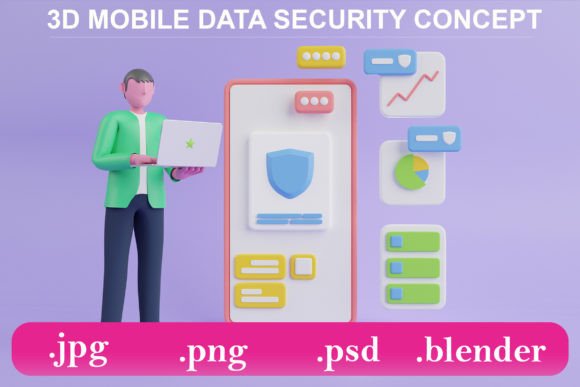
The 3D Mobile Data Security Concept also emphasizes scalability and adaptability. The design files—available in formats like JPG, PNG, PSD, and BLENDER—can be customized to suit various applications. Whether you're creating a website banner, a UI/UX component, or a promotional poster, these assets provide a versatile foundation for incorporating security themes into your work.
Advantages of Using 3D Mobile Data Security Concept
One of the primary advantages of the 3D Mobile Data Security Concept is its ability to enhance user trust. When users see a visually compelling representation of security measures, they are more likely to perceive the associated services or products as reliable and secure. This is particularly important in industries where data privacy is a top concern, such as finance, healthcare, and e-commerce.
Additionally, the 3D Mobile Data Security Concept can improve user education. By using visual storytelling techniques, it becomes easier to explain complex security concepts in a way that is accessible to a broad audience. For example, a 3D animation could demonstrate how end-to-end encryption works, making it easier for users to grasp the importance of secure communication channels.
The flexibility of the 3D Mobile Data Security Concept also allows for seamless integration into different platforms and mediums. Whether you're designing a mobile app interface, creating a marketing campaign, or developing a training module, the concept can be adapted to fit the specific needs of your project. This versatility ensures that the security message remains consistent across all touchpoints.
Practical Use Cases for 3D Mobile Data Security Concept
The 3D Mobile Data Security Concept has a wide range of applications across various industries. In the field of cybersecurity, it can be used to develop interactive training materials that help professionals understand emerging threats and best practices for data protection. These materials can be delivered through online courses, workshops, or internal training programs.
In the realm of marketing and advertising, the 3D Mobile Data Security Concept can be utilized to create eye-catching banners and promotional content that highlight the security features of a product or service. By using high-quality 3D visuals, brands can differentiate themselves in a competitive market and build a stronger connection with their audience.
For web developers and UI/UX designers, the 3D Mobile Data Security Concept offers a powerful tool for enhancing user experience. By incorporating 3D elements into the design of mobile applications, developers can create interfaces that are both functional and visually appealing. This can lead to increased user satisfaction and higher engagement rates.
Considerations When Implementing 3D Mobile Data Security Concept
While the 3D Mobile Data Security Concept offers numerous benefits, there are several factors to consider when implementing it. One of the most important is performance optimization. 3D graphics can be resource-intensive, so it's essential to ensure that the design does not negatively impact the speed or responsiveness of the application or website.
Another consideration is accessibility. Not all users may have access to devices that support advanced 3D rendering, so it's important to provide alternative views or simplified versions of the content. This ensures that the security message reaches a wider audience without compromising the quality of the experience.
Finally, the maintenance and updates of 3D assets should be taken into account. As technology evolves, it may be necessary to update the 3D models and animations to keep them relevant and compatible with new platforms and devices. Regular reviews and improvements can help maintain the effectiveness of the 3D Mobile Data Security Concept over time.
Future Trends in 3D Mobile Data Security Concept
The future of the 3D Mobile Data Security Concept looks promising, with ongoing advancements in 3D design software and mobile technology. As more developers and designers adopt these tools, we can expect to see a greater variety of applications that leverage 3D visuals for security purposes.
One trend to watch is the integration of augmented reality (AR) with 3D Mobile Data Security Concept. AR can enhance the user experience by allowing individuals to interact with 3D security models in real-world environments. This could be particularly useful for demonstrating security protocols in a hands-on manner, making it easier for users to understand and apply them.
Another area of growth is the use of artificial intelligence (AI) to generate and optimize 3D security content. AI-driven tools can analyze user behavior and preferences to create personalized 3D experiences that resonate with different audiences. This level of customization can significantly improve the effectiveness of security messaging and user engagement.